

Organizations deploying AI often try to fit it into existing IT risk management processes, treating a new AI tool the same way they would treat any other software rollout. This approach misses something fundamental about how AI systems actually behave, and it is leaving many organizations with risk exposure their existing frameworks were never designed to catch.
Why Deterministic Risk Models Do Not Fit AI Systems
Traditional IT risk management was built around deterministic systems, software that behaves consistently and predictably based on defined code and configuration. A traditional risk assessment asks whether a system is configured correctly, patched appropriately, and access-controlled properly, largely assuming that if these conditions are met, the system will behave as expected.
AI systems break this assumption. A large language model or machine learning system can produce different outputs for similar inputs, degrade in accuracy over time without any configuration change triggering the decline, and behave in ways that were not explicitly programmed but emerged from training data patterns. A risk framework built entirely around configuration and access control misses these AI-specific failure modes almost completely.
Model Risk: A Category Traditional IT Risk Does Not Address
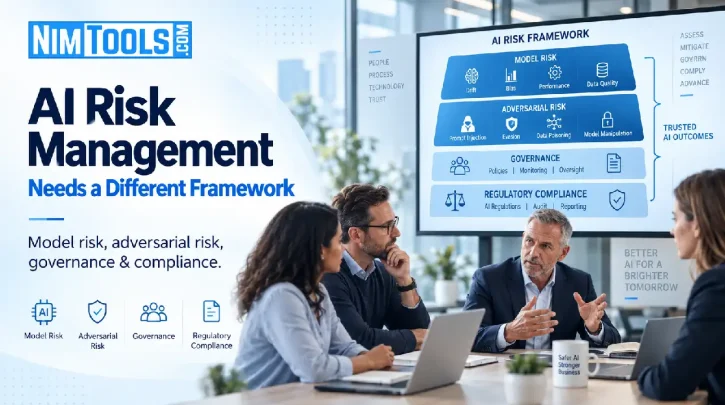
Model risk covers the possibility that an AI system produces inaccurate, biased, or unreliable outputs that affect business decisions. This includes hallucination in generative AI systems, where a model produces plausible-sounding but factually incorrect output with no obvious signal that anything is wrong. It includes bias that emerges from training data and shows up in consequential decisions like hiring, credit scoring, or claims adjudication, often invisibly until an outcome pattern is specifically analyzed for it. It also includes model drift, where a system’s accuracy degrades gradually as real-world conditions diverge from the data it was trained on, without any single event marking the moment performance declined.
None of these risks show up in a traditional IT security scan or configuration audit, because they are not configuration problems. They are properties of how the model itself behaves, which requires ongoing evaluation specifically designed to catch this kind of drift and inconsistency.
Why Adversarial Risk Looks Different for AI Systems
Security teams are well practiced at identifying traditional attack vectors: unpatched vulnerabilities, weak credentials, misconfigured network access. AI systems introduce a distinct category of adversarial risk that does not map cleanly onto these familiar patterns. Prompt injection attacks manipulate an AI system’s behavior through carefully crafted input rather than exploiting a traditional software vulnerability. Data poisoning corrupts a model’s training data to influence its future behavior in ways that may not become apparent until much later. Model inversion attacks attempt to extract sensitive information the model was trained on, a risk with no direct equivalent in traditional application security.
Security teams applying only traditional vulnerability scanning and penetration testing methodologies to AI systems will miss most of these AI-specific attack vectors, since they require evaluation techniques specifically designed around how AI models actually process and respond to input.
Why Governance and Accountability Structures Need to Change
Traditional IT governance generally assigns clear accountability: a specific team owns a specific system, and responsibility for its behavior is relatively easy to trace. AI governance is more complicated, particularly for systems that make autonomous or semi-autonomous decisions. When an AI system produces a flawed output that leads to a business decision, accountability can be genuinely ambiguous: is it the team that deployed the model, the vendor who built it, the team that selected the training data, or some combination that requires more nuanced attribution than traditional IT incidents typically demand.
This ambiguity is exactly why regulators and boards are increasingly asking for explicit AI governance structures rather than assuming existing IT governance automatically extends to cover AI systems adequately.
Why Regulatory Frameworks Are Treating AI as Its Own Risk Category
The regulatory response to these differences has been to build AI-specific frameworks rather than extending existing IT compliance requirements. The NIST AI Risk Management Framework structures risk management around functions specifically designed for AI’s unique characteristics: governing AI use, mapping AI systems and their context, measuring AI-specific risks, and managing identified exposures. The EU AI Act classifies AI systems into risk tiers based on their potential impact, a classification system with no direct equivalent in traditional software regulation. These frameworks exist because regulators have recognized that AI risk is not simply an extension of existing IT risk, but a distinct category requiring its own structured approach.
What This Means for Organizations Building Their AI Risk Program
Organizations that recognize AI risk as a distinct category, rather than folding it into existing IT risk processes, are better positioned to catch the specific failure modes AI systems introduce. This means building evaluation processes specifically designed to detect model drift and bias, security assessments that account for adversarial techniques unique to AI systems, and governance structures that assign clear accountability even when an AI system’s decision-making process is not fully transparent.
Organizations that skip this distinction and simply apply existing IT risk checklists to AI deployments typically discover the gap only after an incident, a biased outcome, a successful prompt injection, a compliance failure, reveals that their existing framework was never designed to catch it in the first place.
How Mindcore Technologies Helps Organizations Build AI-Specific Risk Programs
Mindcore Technologies brings more than 30 years of enterprise risk and compliance experience to the specific challenge of assessing and managing AI risk as its own category. Under the leadership of Matt Rosenthal, CEO of Mindcore Technologies, the company delivers AI risk assessment services built around a multi-dimensional framework that evaluates model risk, security, governance, and regulatory compliance specifically for how AI systems actually behave.
Organizations working with Mindcore get a risk assessment methodology designed around AI’s distinct characteristics, not a traditional IT checklist repurposed for a technology it was never built to evaluate.
Conclusion
AI systems introduce risk categories, model drift, bias, adversarial manipulation, and governance ambiguity, that traditional IT risk management frameworks were never designed to catch. Organizations that treat AI risk as its own discipline, building evaluation processes specifically suited to how AI systems actually behave, are the ones building genuinely defensible risk programs rather than discovering the gaps in a repurposed framework only after an incident reveals them.
About the Author
Matt Rosenthal is the CEO and President of Mindcore Technologies, a full-service IT consulting and cybersecurity firm serving businesses across Florida, New Jersey, Maryland, South Carolina, Louisiana, Texas, and nationwide.
Also Read: The Sweet Spot of Digital Reading
With more than 30 years of experience in enterprise risk management, cybersecurity, and technology strategy, Matt has led the development of AI risk assessment methodologies that address the specific characteristics AI systems introduce beyond traditional IT risk categories. He holds an MBA in Technology Management, is a certified Project Management Professional (PMP), and is the host of Digging In, a weekly podcast on success in business, life, and health.