

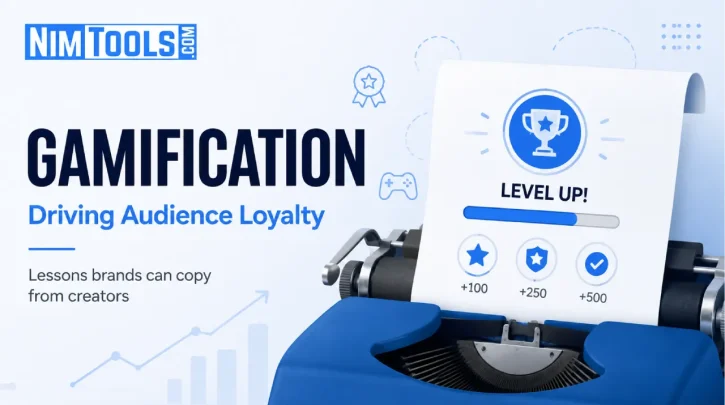
Creators cracked the loyalty code before brands did.
Not with discount engines, CRM workflows, or points currencies — with upload schedules, comment pinning, and membership badges. The mechanics that keep a subscriber returning to a channel every week for three years are the same mechanics that make a customer choose one brand over a cheaper competitor. The vocabulary is different. The psychology is identical.
Here is what gamification actually does inside a loyal audience, and how brands translate each mechanism into a loyalty program that works.
Consistency creates commitment — the streak effect
A creator who uploads every Tuesday conditions their audience’s behavior. By week four, returning on Tuesday feels normal. By week twelve, missing it creates a small but real sense of loss. That rhythm is not an accident — it is a behavioral loop: cue (Tuesday), routine (watch), reward (entertainment or information). The creator never frames it as gamification, but the streak is there.
Retail loyalty programs that understand this build streak mechanics explicitly. Buy three times in a month. Check in five days running. Complete a weekly challenge. The points are not the point — the streak is the engagement driver, and the points are the confirmation that the streak counted.
Brands that skip streaks and go straight to accumulated points miss this entirely. Accumulated points are a savings account. A streak is a habit. Habits outlast promotions.
Tiered access changes the relationship, not just the discount
YouTube Memberships work because the top tier is not simply more of the bottom tier — it is a different relationship. Exclusive videos, direct Q&As, early access, recognition by name during live streams. The premium member is not buying cheaper content. They are buying proximity.
Loyalty programs built on tiered access replicate this precisely when done well. The jump from Silver to Gold should not be “you earn 1.5× points instead of 1×.” It should feel like crossing a threshold into a different kind of membership. Early access to product drops. Invitations to closed events. A dedicated support line that actually picks up. Status that is visible to others, not just stored in an account balance.
Also Read: How Do I Write Better Blog Posts That Rank on Google Faster?
The design mistake most brands make: top-tier perks that only accumulate over time, so a new high-spending customer sees no immediate reason to feel the tier matters. Creator memberships solve this by front-loading visible recognition on day one — the badge appears immediately, the welcome video lands immediately. Loyalty programs need the same first-moment payoff.
Badges make loyalty visible — social proof as a gamification signal
A gold membership badge in a YouTube live chat serves one primary function: it signals status to everyone else in the room. The creator already knows who their members are. The badge is for the audience.
This is an underused mechanism in brand loyalty. When loyalty status is invisible to anyone except the cardholder — tucked inside an app, visible only on the receipt — it loses the social layer that makes badges powerful. Brands that surface tier status in customer-facing contexts give loyal customers something worth holding: identity, not just a balance.
Airlines understood this early. The priority boarding lane is visible. The upgrade is visible. The lounge access is visible. Retail brands that create equivalent visibility — an exclusive packaging variation, a status indicator in community spaces, a recognizable tier name that customers actually use in conversation — are using the same mechanic that keeps YouTube members proud to display their badge.
Time-limited challenges create urgency without discounting
Seasonal creator challenges — upload every day for a month, post a specific format this week — spike participation because the window closes. There is no shortcut to catching up if you miss it. The scarcity creates urgency that no discount can replicate, because the thing being earned is not money — it is access to an experience that existed only within a specific timeframe.
Loyalty programs translate this into flash challenges, double-point weekends, limited seasonal badges, and temporary tier unlocks. The best implementations layer these on top of an evergreen structure: the base program runs continuously, the challenge creates a spike in engagement without making the non-challenge periods feel inadequate.
The critical rule, which creators learn and brands often violate: the challenge must be achievable by a genuinely engaged customer. If the bar is too high, it reads as a marketing trick, and the audience stops trusting the mechanic.
Where creators hit the ceiling
A creator with 200,000 loyal subscribers cannot segment them. Cannot know that 8,000 of them have not opened a video in 45 days and are drifting. Cannot automatically send a re-engagement trigger when someone’s streak breaks. Cannot A/B test whether a streak-based challenge or a badge collection drives higher 90-day retention.
This is the gap between what creators build by instinct and what brands can build with infrastructure. The mechanics are the same — streaks, tiers, badges, challenges — but brands operating at scale need a platform that runs the logic automatically, connects to purchase history across channels, and treats loyalty as a data layer rather than a marketing campaign.
Open Loyalty is a headless loyalty platform built for exactly this: giving product and marketing teams a composable engine to design and run gamification mechanics — tiers, events, challenges, point rules, badges — without being locked into a vendor’s template. Brands in retail, fintech, and multi-market commerce use it to deploy what creators proved works, backed by the behavioral data and automation infrastructure that creators never had.
What to take from this
Creators did not invent gamification. They rediscovered it under pressure, with small budgets and public accountability for every engagement drop. What they found: streaks build habits, tiers shift relationships, badges create identity, and time-limited challenges generate urgency without devaluing the base experience.
Brands have one asset creators do not — transaction data. Applying gamification mechanics on top of real purchase behavior, across digital and physical touchpoints and across the full customer lifecycle, is what separates a loyalty program customers engage with from a discount card they ignore.
The playbook exists. Creators wrote it. Brands just need to run it at scale.