

When “More Tools” Becomes the Problem
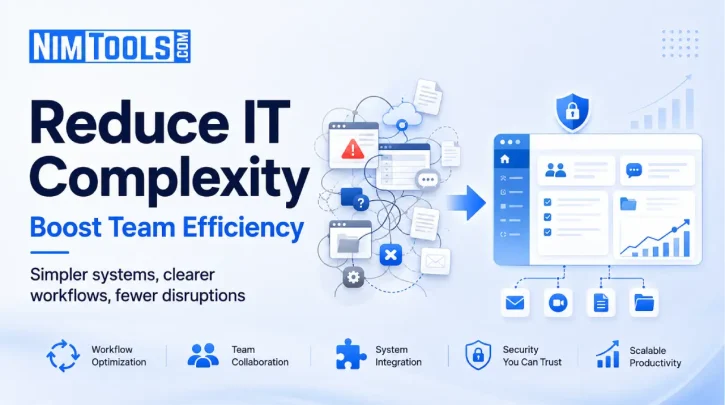
Most businesses don’t plan to create a complicated IT environment. It builds over time. A new platform gets added to solve one issue, another tool is layered in for a different department, and eventually, you have multiple overlapping systems that don’t work well together. While these additions feel like solutions in the moment, over time, everything slows down. Employees spend more time switching between tools, tracking down files, and dealing with small, technical issues than performing their jobs.
How Complexity Slows Your Team Down
Complex systems rarely cause one big failure. Instead, it creates a series of small, daily inefficiencies. When staff have to move between multiple platforms to complete a single task, or when files are scattered across disconnected storage locations, momentum is lost. When technology becomes a hurdle to work around rather than a tool to rely on, frustration rises and output drops.
Simpler Systems Make Work Easier
A more streamlined IT environment removes much of that friction. When systems are organized and built to work together, employees can access what they need faster and complete tasks without unnecessary detours. There is less confusion, fewer workarounds, and less time wasted trying to figure out where things live or how tools connect. Teams can focus on their work instead of managing the systems around it.
Improve Communication Without the Chaos
Communication also improves when tools are simplified. When teams rely on too many platforms that don’t integrate well, messages get missed, files end up in the wrong place, and decision-making slows down. Standardizing communication tools helps solve that problem. When messaging, meetings, and file sharing remain within a smaller, consistent set of platforms, information flows clearly, and collaboration becomes easier.
Also Read : Best Email Forwarding Services For Privacy
Cut Down on Constant Technical Issues
Overly complex systems tend to create more problems than they solve. Poor integration and inconsistent maintenance lead to frequent disruptions. Employees end up restarting software, contacting support, or finding temporary fixes just to keep working. By reducing the number of systems and ensuring systems are well integrated, businesses can lower the probability of interruptions and create a more stable work environment.
Help Your Team Stay Focused
Every extra login, every unfamiliar interface, and every inconsistent tool add friction to the workday. When employees have to constantly adjust to different workflows, it breaks focus and slows momentum. A simplified IT infrastructure eliminates these operational distractions. By ensuring tools are intuitive and workflows are predictable, you allow your team to maintain focus on their core objectives rather than the mechanics of the systems they use.
Make IT Easier to Manage
Complex environments also create challenges for IT teams. Managing multiple platforms, devices, and systems makes it harder to maintain performance and spot issues early. Simplifying the environment improves visibility and control, making it easier to keep systems running smoothly. Many businesses turn towards managed IT services to help reduce complexity, standardize systems, and avoid overloading internal teams.
Strengthen Security by Reducing Risk
Every additional system introduces another potential vulnerability. More tools mean more updates, more access points, and more opportunities for something to slip through. A simplified environment is easier to secure. With fewer systems to manage, it becomes easier to trigger updates, control access, and monitor activity. Businesses utilizing managed IT services often streamline their technology for this exact reason.
Set Your Business Up for Scalability
Growth can make complexity worse if there’s no plan in place. New tools are added quickly to solve short-term problems, but over time, they create long-term inefficiencies. Reducing complexity now creates a stronger foundation for scaling later. When systems are integrated and structured properly, businesses can grow without adding unnecessary layers of technology.
Prioritizing What Matters
More technology doesn’t always mean better results. In many cases, it just creates more friction. Simplifying your IT environment helps your team work faster, reduces daily frustrations, and makes systems easier to manage and secure. If your employees spend more time dealing with tools instead of using them, the issue isn’t effort, it’s complexity.