


For years, enterprise infrastructure planning started with VMware. The operating model was familiar, the skills were available, and the surrounding ecosystem was mature. But today, many IT leaders are looking beyond a single virtualization layer.
The real question is no longer, “What should replace the hypervisor?” It is, “What kind of infrastructure will support the business over the next five or ten years?” It is all about thinking long term.
A conventional VMware replacement project can solve an immediate licensing or vendor-dependency concern, but it may leave the broader architecture untouched.
An integrated cloud infrastructure platform creates a different path. It brings compute, storage, networking, security, management, and cloud services into a more coordinated environment.
Why VMware-Centric Infrastructure Is Being Reconsidered
Many organizations have built years of operational knowledge around vSphere, vCenter, established backup processes, and familiar administrative workflows.
Reconsidering that environment is therefore not a small technical exercise. It affects people, processes, application dependencies, support relationships, and business continuity.
Also Read: How iTop Easy Desktop Helped Me Stop Wasting Time Looking For Files
This is where some migration discussions go wrong because they focus heavily on license comparisons while giving less attention to workload stability or operational familiarity.
For instance, a lower-cost hypervisor may appear attractive on paper. Still, enterprises also need to verify if the alternative can:
- Support existing applications
- Integrate with current hardware
- Maintain recovery policies
- Give administrators a manageable learning curve
A credible VMware vSphere Alternative should help an organization preserve important operating habits while opening a route toward broader modernization.
Does moving away from VMware require a complete infrastructure rebuild?
Sangfor supports a phased approach in which enterprises can begin with virtualization migration while retaining parts of their existing storage, networking, and hardware environment. This gives VMware customers room to test applications, move workloads in controlled groups, and modernize according to operational priorities.
From a Virtualization Platform to a Cloud Operating Model
A virtualization platform abstracts server resources and allows multiple virtual machines to share physical infrastructure.
Teams are being asked to manage distributed applications, private cloud resources, disaster recovery, security policies, containers, remote sites, and emerging AI requirements.
This is to be done without adding another collection of disconnected consoles. An integrated cloud infrastructure platform responds by treating infrastructure as one operating environment.
Sangfor HCI unifies compute, storage, networking, security, and management within a software-defined stack. Sangfor Cloud Platform then extends this foundation toward centralized cloud management and coordinated service delivery.
In fact, this HCI architecture is described as supporting business-critical applications along with private, public, and hybrid cloud development.
A hypervisor comparison often asks which platform can host a virtual machine. A broader cloud comparison asks how quickly infrastructure can be provisioned, protected, monitored, recovered, scaled, and governed.
That second group of questions is closer to what mid-market and large enterprises actually need.
HCI as the Practical Bridge to Private Cloud
HCI has become a useful middle ground between traditional three-tier architecture and a fully developed cloud model: it removes several infrastructure silos while keeping resources under enterprise control.
For organizations with governance, latency, sovereignty, or application-dependency requirements, that makes HCI a practical foundation for building a private cloud.
For judging a modern HCI platform, IT teams should review availability architecture, backup and disaster recovery, hardware compatibility, lifecycle management, scalability, security controls, application support, and the migration experience.
It is also worth examining how the platform behaves after deployment.
Simple provisioning is useful, but daily troubleshooting, capacity planning, and policy management shape long-term operational outcomes.
Sangfor’s Hyperconverged Infrastructure brings compute, storage, networking, security, and management together in one software stack. That integrated design can reduce the friction created by separate management domains.
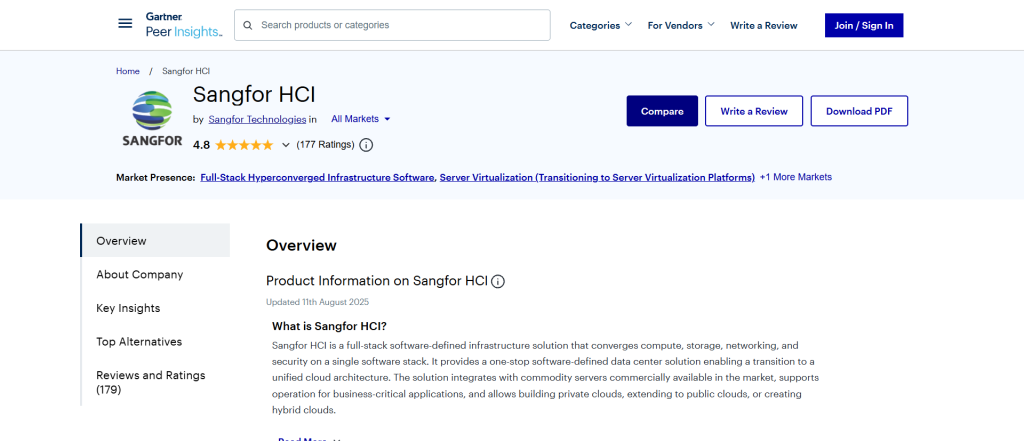
Customer feedback offers another useful signal. Gartner Peer Insights currently lists it at 4.8 out of 5 based on 177 ratings.
Peer reviews are not a substitute for technical validation.
But they can help evaluation teams understand real-world views on management, deployment, support, and cloud infrastructure platform operation.
Is Sangfor HCI suitable only for organizations in Asia-Pacific?
Sangfor is a global cloud computing and cybersecurity provider with operations across EMEA, Latin America, and APAC. Naturally, this HCI is intended for enterprises evaluating integrated infrastructure across different regions. This is inclusive of organizations that need private cloud, hybrid cloud, disaster recovery, and VMware migration capabilities.
Migration Has to Protect Operational Continuity
Before moving production workloads, enterprises need application discovery, dependency mapping, performance baselines, and recovery objectives.
Applications can then be grouped by risk and moved in stages; this begins with workloads that offer a useful technical test without placing critical services in danger.
Indonesian broadcaster SCTV adopted Sangfor aSV, aNET, and Sangfor Cloud Platform while retaining Dell and Hitachi external storage. The project focused on moving VMware-dependent media, SAP, database, file-server, and broadcast workloads with minimal service interruption.
Infrastructure teams do not want migration for its own sake: they want a controlled route that protects existing investments and keeps critical services stable. Good infrastructure always moves at the pace the business can safely absorb.
Building Infrastructure for the AI Era
AI readiness means the infrastructure should not become a barrier when demand arrives.
Data-intensive workloads require scalable compute and storage, dependable networking, stronger security controls, and an operating model that can accommodate both conventional and emerging applications.
Therefore, VMware replacement should be viewed as a modernization opportunity rather than a purchasing event.
Enterprises can use the transition to simplify operations, establish a private cloud foundation, and prepare for hybrid and AI-enabled services.
In June 2026, the company reported that Gartner’s Market Share: Data Center Hardware Integrated Systems, Worldwide, 4Q25 ranked Sangfor among the five largest HCIS vendors by 2025 revenue in Asia-Pacific. The same announcement stated that the company ranked sixth worldwide by revenue.
A Shift That Should Be Deliberate
Moving beyond a VMware-centric model is not about rejecting virtualization, which remains central to enterprise IT.
The shift is about placing it inside a more integrated cloud infrastructure platform that can support cloud operations, resilience, and security.
Sangfor offers mid-market and large enterprises a practical route through that change. By combining familiar virtualization operations with HCI and cloud management, the company allows organizations to modernize in stages.