


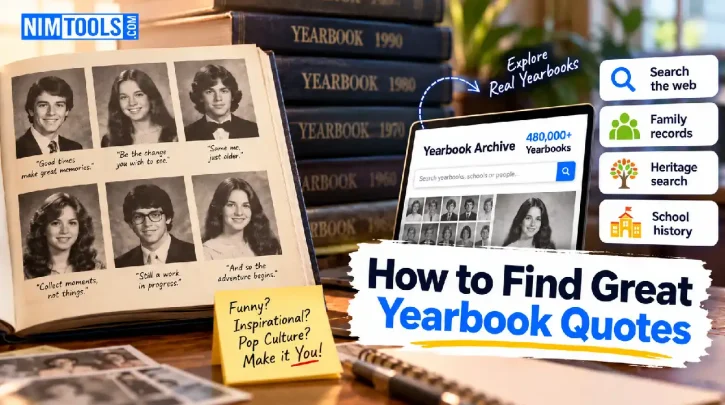
Yearbook quotes have a special ability to capture someone’s personality in only a few words. They can be funny, thoughtful, ambitious, sentimental, or wonderfully strange. Read decades later, they also provide small glimpses into the humor, language, popular culture, and attitudes of a particular generation.
If you are searching for inspiration for your own yearbook quote, looking for something a relative once wrote, or simply curious about what students have said over the decades, original yearbooks are an excellent place to start. Rather than relying exclusively on lists of famous sayings, you can explore quotes that students actually chose to place alongside their photographs.
Also Read: Why AI Risk Management Requires a Different Framework Than Traditional IT Risk
The internet has made this considerably easier. Classmates, Google, Ancestry, MyHeritage, and FamilySearch can all help you find yearbooks, identify former students, or uncover the information you need to locate a particular school record.
Start by Deciding What Kind of Quote You Want
Before searching, think about what you actually hope to find. Someone looking for a funny graduation quote will approach the search differently from someone trying to discover what their grandfather wrote in his senior yearbook. If you are looking for inspiration, consider a few broad categories. Funny quotes, inspirational messages, pop culture references, comments about school life, predictions for the future, and short observations about friendship are all worth exploring.
You can also search by decade. Humor and popular expressions change considerably over time, so looking at quotes from different generations can produce far more interesting results than searching only for contemporary examples.
Explore Real Yearbooks with Classmates
One of the most direct places to search is Classmates, particularly if you want to see quotations in their original yearbook context. Classmates has more than 480,000 yearbooks in its collection, covering schools and students throughout the decades.
That enormous collection provides opportunities to discover millions of quotes in real books rather than seeing lines reproduced without their original context. You can explore yearbooks from different periods and see how students chose to represent themselves at the time.
Browsing older books can be particularly entertaining. A quote that made perfect sense to a teenager in the 1960s might sound unexpectedly formal today, while something written during the 1980s or 1990s may be packed with slang or cultural references associated with those decades. The surrounding pages provide valuable context too. You can see portraits, school activities, clubs, sports, fashions, and other details alongside the quotes. This makes browsing yearbooks an interesting form of social history as well as a source of inspiration.
If you know the school or graduating year you are interested in, begin there. Otherwise, exploring books from different decades can help you discover unusual approaches that would be difficult to find through a conventional quote search.
Use Google for Targeted Searches
Google is useful when you already have a general idea of the type of quotation you want. Search phrases can be made as broad or specific as necessary. For example, you could search for humorous senior quotes from a particular decade, inspirational graduation sayings, or unusual quotes associated with a particular school. Adding a year, town, school name, or other identifying information can narrow down large numbers of results.
Google can also help when you remember only part of a quote. Putting the words you remember inside quotation marks may uncover other appearances of the same phrase. The challenge is determining where a quotation originally came from. Popular yearbook quotes are frequently reposted on websites and social media without any information about the student or yearbook in which they appeared. When authenticity matters, try to trace the quote back to an original source.
Search Ancestry for Family Yearbook Connections
Yearbook research becomes particularly interesting when it involves your own family. Ancestry can help establish information about relatives, including names, locations, approximate ages, and schools associated with particular periods of their lives. This information can provide the clues needed to search for an original yearbook.
Imagine discovering the senior quote selected by a grandparent when they were 17 or 18. It might reveal an ambition they later pursued, a joke that still sounds like them decades later, or an unexpected side of their personality. Be prepared to experiment with names. Women may appear under maiden names, while initials, nicknames, middle names, and spelling variations can all affect search results.
Investigate Family History with MyHeritage
MyHeritage can serve a similar purpose when you are trying to identify where and when a relative attended school. Historical and family records may provide information that helps narrow down the correct location and period. Even when a search does not immediately produce a yearbook, identifying someone’s hometown, age, and likely graduation year can substantially reduce the possibilities.
Once you have established those details, you can use them to search more specifically elsewhere. This is particularly useful when researching older generations whose school history may not be immediately known by living family members.
Use FamilySearch to Fill In Missing Details
FamilySearch is another useful resource when the challenge is identifying the person behind the quote rather than simply finding entertaining quotations. Genealogical records can help establish full names, family relationships, dates, and locations. Those details can then provide a foundation for searching school-related records. This approach is particularly valuable when you have inherited a photograph, yearbook page, or family story without much context. Building a basic timeline of someone’s teenage years may reveal where they were likely attending school and when they would have graduated.
Search by Decade for More Unusual Inspiration
Looking across different decades is one of the best ways to avoid finding the same quotes repeatedly. Students have always used humor, but the references change dramatically. Older yearbooks may contain literary quotations, formal expressions, or comments about future careers. Later books may feature movie references, song lyrics, television jokes, slang, and comments about technology.
Looking at these changes can inspire a quote without simply copying somebody else’s words. You might notice a particular structure or sense of humor and then adapt the idea to reflect your own personality.
Find Something That Feels Personal
The most memorable yearbook quotes are not always profound. Sometimes the best ones are funny, slightly awkward, optimistic, or completely representative of the person who chose them.
Exploring Classmates’ 480,000-plus yearbooks provides access to millions of examples from real books, while Google can broaden the search, and Ancestry, MyHeritage, and FamilySearch can help when you are investigating a particular person or family connection.
Also Read: The Sweet Spot of Digital Reading
The goal does not have to be finding the most famous quotation ever written. Looking through what generations of students actually chose to say can provide much better inspiration. Somewhere among decades of jokes, ambitions, observations, and school memories, you may find an idea that helps you create a yearbook quote that genuinely sounds like you.